
Table of Contents
- From Formula to Shelf: How to Market Your Melt-to-Make™ Gummies for Maximum Impact (Clean Label Marketing Strategies)
- Clean Label Is No Longer a Trend — It’s an Expectation
- Lead With What Consumers Care About
- Claims You Must Register For vs. Claims You Don’t
- Make Your Differentiation Obvious at First Glance
- FAQs
From Formula to Shelf: How to Market Your Melt-to-Make™ Gummies for Maximum Impact (Clean Label Marketing Strategies)
As a B2B partner, we know your job doesn’t stop at formulation. Your product doesn’t just need to be created, its needs to win on the shelf, online, and in the consumer’s hands. That's where clean label marketing strategies come into play.
Today’s shoppers read labels differently than they did five years ago. They scan for ingredients they recognize, transparency, and modern formulation. If you’re using Melt-to-Make™, you already have meaningful advantages.
The key is making sure your packaging communicates them clearly and confidently, telling your customers that you have their best interest in mind.
Clean Label Is No Longer a Trend — It’s an Expectation
The shift toward cleaner ingredients isn’t slowing down. Consumers now expect:
Recognizable ingredients
Fewer artificial additives
Transparent sourcing
Modern plant-based formulation
Brands that clearly communicate these attributes build faster trust — and trust shortens the buying decision.
If your product already meets these expectations, your packaging should confidently communicate that strength. And if it doesn’t, it may be time to reassess whether your formulation aligns with where the market is heading.
Lead With What Consumers Care About
Consumers don’t analyze ingredient panels like food scientists. They look for reassurance, and things they can recognize.
When manufacturing gummies with Melt-to-Make™, your product is positioned to communicate powerful, purchase-driving claims such as:
1. Clean & Free From
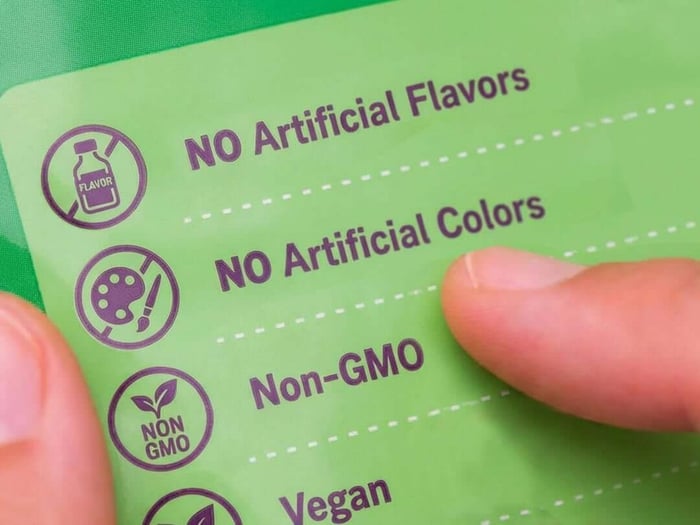
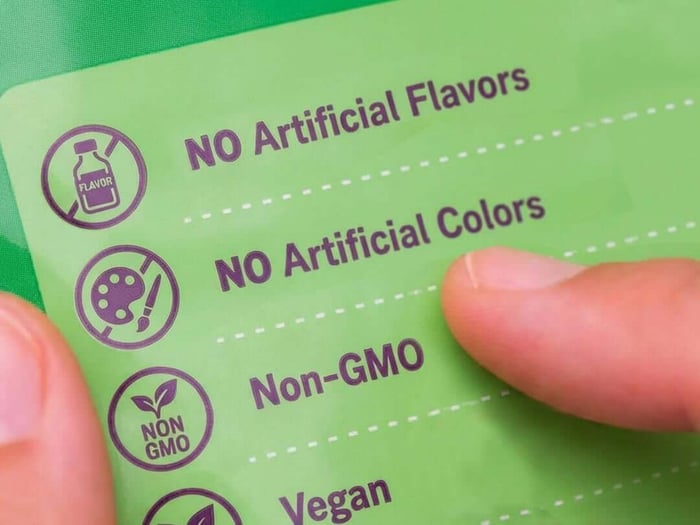
No Artificial Flavors
No Artificial Colors
No Artificial Ingredients
Vegan / Plant Based
Non GMO
Kosher
“Free from” language is one of the strongest psychological drivers in modern packaging.
It signals:
Simplicity
Fewer unknowns
Reduced risk
Greater trust
Whether or not a consumer fully understands ingredient chemistry, they instinctively associate “no artificial ingredients” with cleaner, more thoughtful formulation.
If your product delivers that benefit, don’t bury it. Highlight it as much as you can!
2. Plant-Based (Vegan) & Transparently Sourced
Plant-Based (Vegan) Pectin
Non-GMO Ingredients
“Plant-based” now communicates more than dietary preference — it signals modern values, natural sourcing, and intentional product development.
Even non-vegan consumers perceive plant-based ingredients as cleaner, more sustainable, and better aligned with wellness
“Non-GMO” continues to act as a shorthand for transparency and ingredient integrity. It reassures shoppers who prioritize thoughtful sourcing and want confidence in what they’re consuming.
3. Facility Regulations
At Melt-to-Make™, we manufacture in an FDA-registered facility that adheres to strict GMP (Good Manufacturing practices) standards. If your own facility operates under the same regulatory framework, you can reinforce that commitment to safety and quality in your finished product messaging. This creates two distinct layers of trust: one rooted in clean, thoughtfully sourced ingredients, and another grounded in rigorous manufacturing standards.
If you're operating as a cannabis or hemp brand, you do have the option of registering as a GMP facility, but not as a FDA registered manufacturing facility.
Claims You Must Register For vs. Claims You Don’t
Some claims require formal registration or certification before they can be used. These include designations such as FDA Registered, GMP Certified, Organic, and Kosher.
Claims you don't have to register for but can still include on your packaging include but are not limited to: Vegan, All-Natural, No Artificial Colors, and No Artificial Flavors.
If you have questions on this topic, please feel free to contact our quality team at support@melt-to-make.com
Many of these regulation badges are open to design interpretation. However, the Non-GMO claim is more structured. The version I shared previously is the standard emblem, but in order to use it, you would need to complete the appropriate certification process through the Non-GMO Project and ensure all ingredients meet those requirements. Alternatively, you can still make a Non-GMO claim if you don't go through that process, but you would not be able to use that certified logo. Additionally, even if you don't go through the process, you would need proof that all your ingredients in the final product are Non-GMO certified. I’ve attached our certification for your records and I've looped in our Quality Manager if you have any other questions regarding this.
Additional Notes on Non-GMO Claims
Many regulatory-style badges are open to design interpretation. However, the Non-GMO claim is more structured.
To use the official Non-GMO logo, you must complete the certification process through the Non-GMO Project and ensure all ingredients meet their requirements.
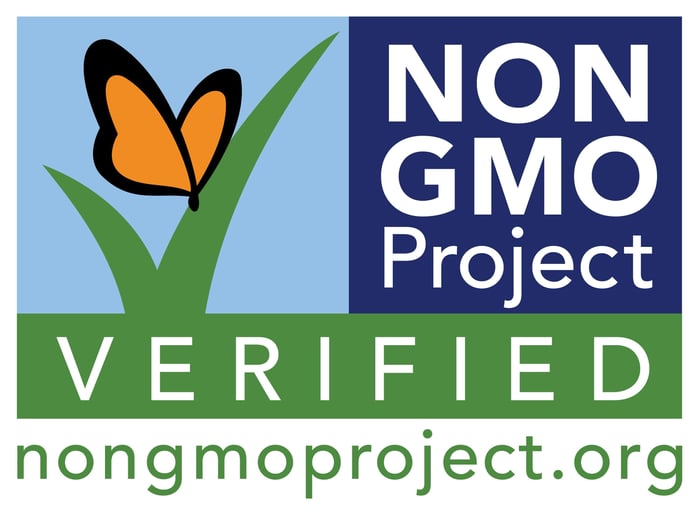 Official Non-GMO Label
Alternatively, you may still make a Non-GMO claim without certification, provided you have proper documentation verifying that all ingredients in your final product are Non-GMO. However, in this case, the certified logo cannot be used.
Make Your Differentiation Obvious at First Glance
Your front-of-pack should answer one question instantly:
“Why should I choose this over the one next to it?”
Best practices:
Prioritize your strongest, most relevant claims
Use clean, readable callouts
Avoid overcrowding
Ensure all claims are properly substantiated and compliant
If your competitive advantage is hidden in the ingredient panel, you’re asking consumers to work too hard.
Clarity drives sales.
Consolidate Claims for Stronger Impact
More badges do not equal more persuasion.
Instead of scattering claims across your packaging, consider grouping complementary attributes to create a clear product identity.
For example:
Plant-Based • Non-GMO • No Artificial Ingredients
This positioning tells a cohesive story instead of presenting disconnected features.
Align Your Messaging Across Every Channel
Your packaging claims should be mirrored in:
Website copy
E-commerce listings
Distributor sell sheets
Retail buyer presentations
Social media
Inconsistency creates doubt, but consistency builds credibility. If your product is clean, plant-based, and thoughtfully manufactured — every touchpoint should reinforce that message and what your brand stands for. Clean label marketing strategies should be implemented to tell the story of your product and brand.
The Bottom Line
A superior formula does not automatically translate to superior sales, but clean label marketing strategies do.
Growth happens when your advantages are clear, credible, and emotionally resonant.
If you’re using Melt-to-Make™, you already have meaningful differentiation built into your product. It's time to make sure your customer can see it!
FAQs
What is clean label marketing?
Clean label marketing is the strategic communication of simple, transparent, and recognizable ingredients to build consumer trust. It typically emphasizes claims such as “no artificial ingredients,” “plant-based,” and “non-GMO” to signal product integrity and modern formulation.
For brands using Melt-to-Make™, clean label marketing helps translate formulation advantages into shelf impact and stronger consumer engagement.
Which clean label claims resonate most with consumers?
Consumers respond most strongly to:
No Artificial Flavors
No Artificial Colors
No Artificial Ingredients
Plant-Based Ingredients
Non-GMO
“Free-from” messaging reduces perceived risk, while plant-based positioning signals modern, thoughtful formulation. The most effective packaging highlights these benefits clearly and confidently.
Can I claim “Plant-Based” or “Vegan” if I use Melt-to-Make™?
If your finished product is formulated entirely with plant-based ingredients and meets applicable regulatory definitions, you may be able to use plant-based or vegan positioning.
Because labeling compliance depends on your full ingredient panel and production process, you should confirm eligibility before making these claims.
Can I state that my product is made in an FDA-registered, GMP-compliant facility?
Melt-to-Make™ products are manufactured in an FDA-registered facility operating under GMP standards.
However, your ability to extend that claim to your finished product depends on your own production facility’s registration and compliance status. Always verify your facility’s qualifications and labeling compliance before including regulatory claims on packaging. If you are compliant, this is a huge way for you to market your product.
How many claims should I feature on my packaging?
More is not always better. Overloading packaging with badges can dilute your message.
Instead, prioritize 2–4 complementary claims that create a clear identity, such as:
Plant-Based • Non-GMO • No Artificial Ingredients
Strong positioning builds confidence faster than a long checklist.
Why is regulatory transparency becoming more important in marketing?
Recent FDA modernization efforts and increased consumer awareness around food safety have made manufacturing standards more visible. Consumers increasingly care not just about what’s in a product, but how it’s made.
Highlighting compliant, high-quality manufacturing practices — when applicable — adds a second layer of trust beyond ingredient transparency.
How does clean label positioning impact sales?
Clean label positioning reduces hesitation at the point of purchase. Customers experience greater confidence in your product, knowing that what they purchase from you is of the highest quality.
Clear communication turns formulation strength into measurable growth.