
Table of Contents
- What Is Water Activity in Gummies?
- Melt-to-Make® Recommended Finished Gummy Water Activity
- The Relationship Between Gummy Water Activity and Gummy Heat Resistance
- Why Water Activity Matters for Gummy Coatings
- Don't Determine Gummy Dryness by Feel Alone
- Gummy Water Activity Testing Doesn't Have to Be Expensive
- Build Finished Water Activity Into Your Gummy Manufacturing Process
- Better Gummy Manufacturing Starts With Better Process Control
- Questions?
- FAQs
Gummy Water Activity in Manufacturing
Why does gummy water activity matter?
Gummy manufacturers spend countless hours optimizing formulations, cooking parameters, depositing temperatures, drying conditions, and production processes. But one of the most important gummy quality metrics is often overlooked:
Finished water activity (Aw).
At Melt-to-Make®, finished water activity is an important part of our product specifications because it can directly influence how a gummy performs throughout its shelf life.
Getting the gummy out of the depositor is only part of the job. The finished product also needs to maintain its intended texture, coating, appearance, and stability through packaging, shipping, storage, and ultimately consumption.
That's why we recommend manufacturers treat finished water activity as a process target, not simply another QC measurement.
What Is Water Activity in Gummies?
Water activity, or Aw, describes the availability of water within a product.
Finished Aw can affect several important characteristics of a gummy, including:
Shelf stability and product longevity
Microbial stability
Texture consistency
Sugar and sour-sugar coating performance
Wax and oil coating performance
Heat resistance during shipping and storage
Overall finished-product consistency
For manufacturers using Melt-to-Make® gummy products, controlling finished water activity is an important part of achieving the intended finished-product performance.
Melt-to-Make® Recommended Finished Gummy Water Activity
Based on our product specifications and manufacturing experience, Melt-to-Make recommends the following finished water activity ranges:
Pectin Gummies: 0.57–0.63 Aw
Gelatin/Pectin Blend Gummies: 0.57–0.63 Aw
Gelatin Gummies: 0.65–0.67 Aw
These are the finished Aw ranges we recommend when manufacturing with our products to help achieve the texture, stability, coating performance, and overall product characteristics they're designed to deliver.
That means gummy manufacturers shouldn't simply follow a predetermined drying time and assume the product is finished.
Drying time can change based on environmental conditions, gummy size, formulation, equipment, room conditions, and other manufacturing variables. Finished water activity gives manufacturers an objective measurement of the product itself, insuring it's quality and shelf stability.
View the Melt-to-Make Drying Guide
Unflavored Pectin Gummy Base | 10 Kg | Melt-to-Make®
$224.00
Melt-to-Make® Unflavored Pectin Gummy Base gives gummy manufacturers a reliable, plant-based foundation for clean-label gummies at scale. In addition, this unflavored pectin gummy base provides a neutral profile, allowing for complete customization of flavor, color, and finishing options while maintaining… read more

The Relationship Between Gummy Water Activity and Gummy Heat Resistance
One of the most significant benefits we've observed involves gelatin/pectin blend gummies.
We've found that drying a gelatin/pectin blend to a pectin-like finished water activity of approximately 0.57–0.63 Aw can dramatically improve heat tolerance.
In our experience, gummies manufactured this way have maintained their structure at temperatures approaching 150°F.
The same formulation finished at a higher water activity does not demonstrate the same level of performance.
That's significant for manufacturers concerned about gummies softening or deforming during warm-weather shipping and storage.
Traditional gelatin gummies typically begin to soften around 98–100°F. By combining gelatin and pectin and controlling the finished water activity, manufacturers can produce a gummy with substantially different performance characteristics and shelf quality.
Why Water Activity Matters for Gummy Coatings
Finished Aw can also have a major impact on gummy coating performance.
This is particularly important for manufacturers producing:
Sugar-coated gummies
Sour sugar gummies
Wax-coated gummies
Oil-coated gummies
A gummy that hasn't reached the appropriate finished condition can create problems during coating or later in the product's shelf life.
Manufacturers may see sticking, coating deterioration, changes in surface texture, or inconsistent finished products.
Reaching the recommended finished Aw before coating and packaging helps create a more predictable process and a more consistent finished gummy.
Why are my gummies Sweating & Sticky?
https://melt-to-make.com/a/blog/why-are-my-gummies-sweating-and-sticky
Don't Determine Gummy Dryness by Feel Alone
Experienced gummy operators develop an intuitive understanding of their products.
That experience is valuable—but it shouldn't replace objective process measurements.
A gummy can look finished, feel finished, and taste finished while still being outside its target water activity.
That's why Melt-to-Make recommends incorporating water activity measurements into the manufacturing process.
Instead of asking:
“Does this gummy feel dry enough?”
Manufacturers can ask:
“Has this gummy reached its target Aw?”
That small change turns a subjective production decision into a measurable specification.
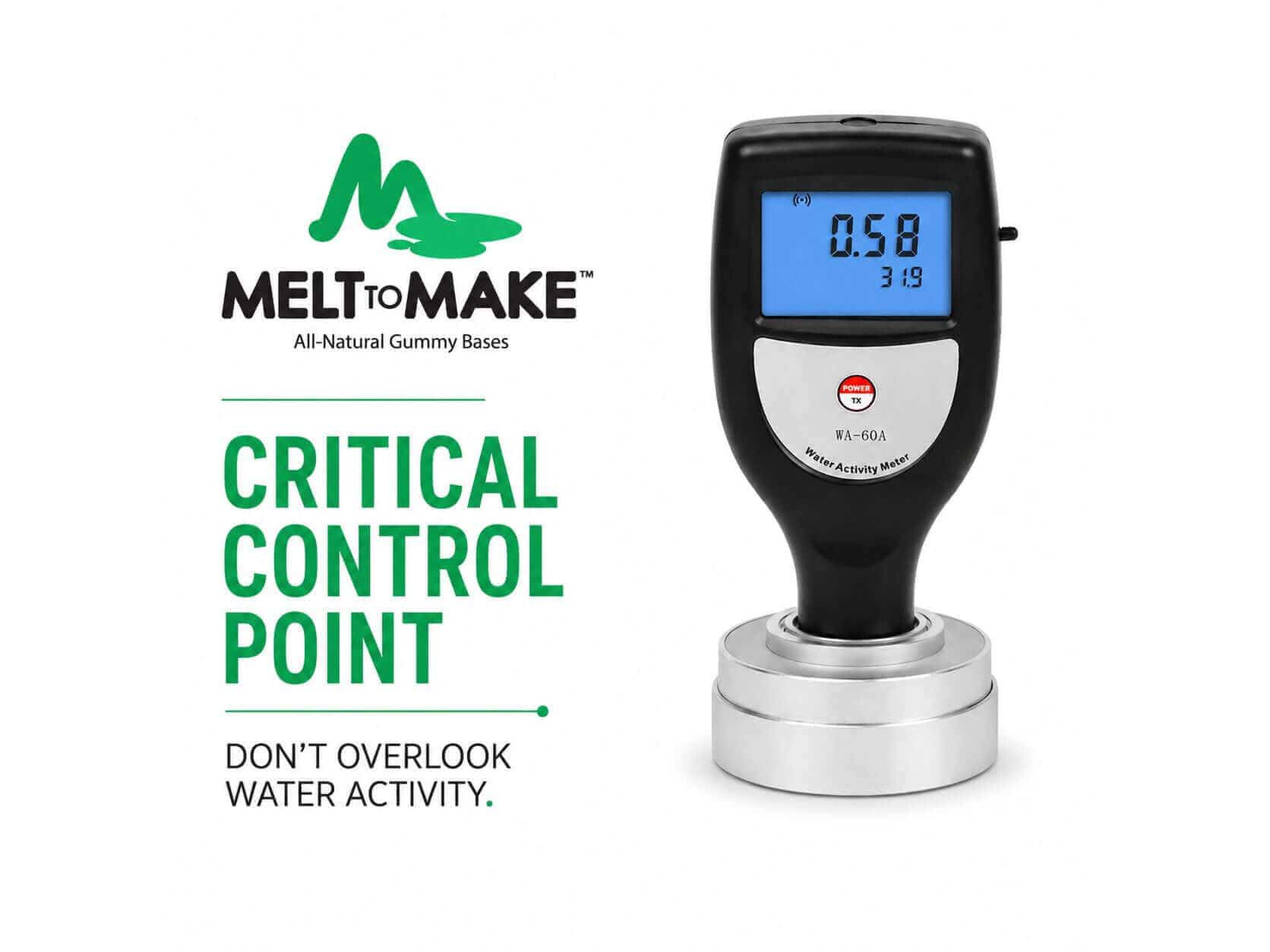
Gummy Water Activity Testing Doesn't Have to Be Expensive
Cost is sometimes cited as a reason manufacturers don't routinely measure water activity.
That barrier has become much smaller.
Today, reasonably capable entry-level water activity meters can be purchased for approximately $500.
https://capplustech.com/product/portable-water-activity-meter-moisture-analyzers/
An inexpensive meter won't replace a high-end laboratory instrument where laboratory-level accuracy, calibration, documentation, or validation is required.
But for a manufacturer currently relying exclusively on operator intuition to determine when gummies are “dry enough,” routine Aw measurement can provide significantly more useful process information.
Build Finished Water Activity Into Your Gummy Manufacturing Process
Finished water activity shouldn't be something manufacturers think about only after a gummy has been produced.
It should be considered throughout the manufacturing process.
For manufacturers working with Melt-to-Make products, that means producing toward a defined finished specification.
The result is a more controlled and repeatable gummy manufacturing process, along with a product that confidently performs on the shelf.
Better Gummy Manufacturing Starts With Better Process Control
The goal isn't simply to produce gummies that look great when they come off the line.
The goal is to manufacture gummies that continue to perform as intended weeks and months after production.
Finished water activity is one of the most valuable tools manufacturers have for achieving that consistency.
Melt-to-Make gummy bases are designed to simplify gummy manufacturing while giving manufacturers greater control over the finished product.
If you're producing gummies at commercial scale, or looking for a more consistent way to manufacture pectin, gelatin, or gelatin/pectin gummies, explore Melt-to-Make gummy manufacturing solutions and see how the right formulation and process specifications can help you produce better gummies, batch after batch.
Questions?
FAQs
What is the ideal water activity for gummies?
The ideal finished water activity depends on the gummy formulation. Melt-to-Make® recommends 0.57–0.63 Aw for pectin gummies and gelatin/pectin gummies, and 0.65–0.67 Aw for gelatin gummies manufactured with Melt-to-Make® products.
Why is water activity important in gummy manufacturing?
Finished water activity can affect shelf stability, microbial stability, texture, coating performance, heat resistance, and overall product consistency. Measuring Aw gives manufacturers an objective way to determine whether gummies have reached their intended finished condition.
Can water activity affect gummy shelf life?
Yes. Finished Aw is an important factor in how gummies perform during packaging, storage, shipping, and shelf life. Manufacturers should establish an appropriate Aw specification for their formulation and monitor it consistently between batches.
Can water activity affect gummy heat resistance?
Yes. Finished Aw can influence gummy texture and heat performance. Melt-to-Make® has observed that gelatin/pectin gummies finished to approximately 0.57–0.63 Aw can demonstrate significantly improved heat tolerance compared with the same formulation at a higher finished Aw.
How do I know when gummies are finished drying?
Rather than relying only on drying time, appearance, or feel, manufacturers should measure finished water activity with a calibrated water activity meter. Drying time can vary with gummy size, formulation, equipment, temperature, humidity, and other production conditions, so measuring the product itself provides a more objective endpoint.